 Abubakar Siddiq Ibn Usman
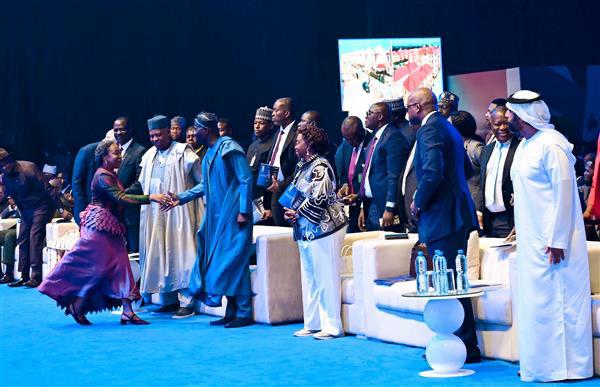
In a major move to bolster the Renewed Hope economic agenda, President Bola Ahmed Tinubu on Tuesday witnessed the signing of a historic Comprehensive Economic Partnership Agreement (CEPA) between Nigeria and the United Arab Emirates (UAE).
The agreement, signed on the sidelines of the 2026 Abu Dhabi Sustainability Week (ADSW), is set to eliminate tariffs on over 7,000 Nigerian products, providing a massive boost to the nation’s non-oil exports and industrialization goals.
The pact was finalized in the presence of President Tinubu and the UAE President, His Highness Sheikh Mohamed bin Zayed Al Nahyan.
The formal signing was conducted by Nigeria’s Minister of Industry, Trade and Investment, Dr. Jumoke Oduwole, and the UAE Minister of Foreign Trade, Dr. Thani bin Ahmed Al Zeyoudi.
Speaking after the ceremony, President Tinubu emphasized that the agreement is a “purposeful engagement” designed to serve Nigeria’s long-term national interests.
“For Nigerians, this agreement is not abstract. It opens duty-free access for thousands of Nigerian products into the UAE, expands opportunities for our exporters, and gives UAE investors clearer confidence to back Nigeria’s productive economy,” the President stated.
Read also:Petrol price war: Retailers undercut Dangote’s ₦739 benchmark
Key highlight of the agreement.
The agreement marks one of Nigeria’s most ambitious bilateral trade deals. According to details released by the Ministry of Industry, Trade and Investment, the trade liberalisation follows a strategic timeline:
- Immediate Duty-Free Access: The UAE will immediately eliminate tariffs on over 7,000 products, including fish, seafood, cereals, cotton, pharmaceuticals, and chemicals.
- Phased Removal (3–5 Years): Tariffs on Nigerian-made machinery, vehicles, electrical equipment, apparel, and furniture will be phased out over the next few years.
- Reciprocal Openness: Nigeria will reciprocate by liberalizing approximately 6,243 products, focusing on industrial inputs and capital goods to support local manufacturing.
- Investment Security: The deal provides a legal framework to protect Nigerian businesses in the UAE and encourages Emirati investment in Nigeria’s renewable energy, logistics, and digital trade sectors.
In addition to the trade pact, President Tinubu announced that Nigeria will co-host the global investment platform, Investopia, in Lagos this February. The summit aims to mobilize up to $30 billion annually in climate and green industrial finance.
“We are moving from ideas to bankable investments,” Tinubu noted, inviting global partners to view Nigeria as the premier gateway for trade and investment into the African continent.
Industry experts suggest the CEPA could unlock over $10 billion in fresh investments. By removing longstanding barriers to Foreign Direct Investment (FDI), the agreement is expected to create thousands of jobs for Nigeria’s youthful population and integrate local manufacturers into global value chains.
The Minister of Industry, Trade and Investment, urged the Nigerian private sector to take full advantage of the new market access, noting that the agreement was specifically “negotiated for the Nigerian entrepreneur.”


 Agency News